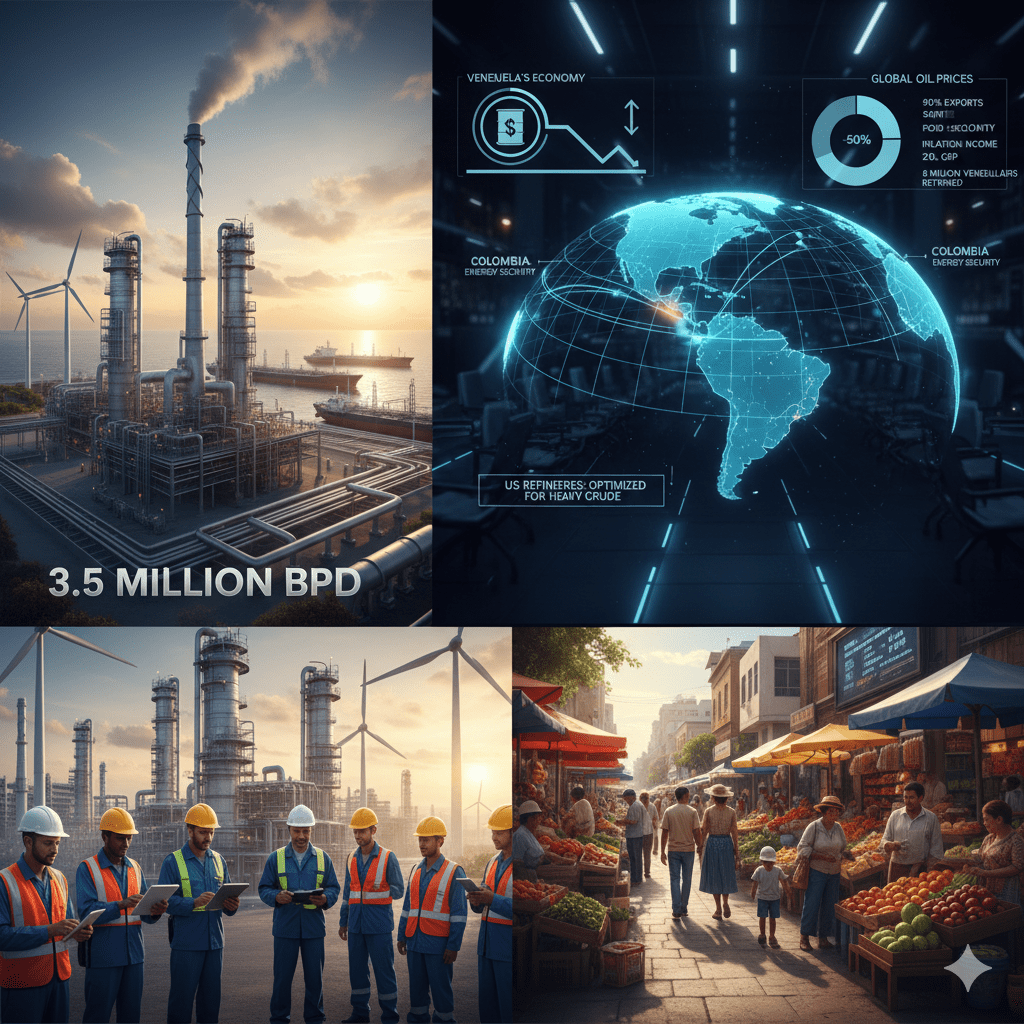
Oil and gas revenues are the backbone of the Venezuelan economy, historically accounting for ~90% of export revenues, ~50% of the government’s fiscal income, and ~20% of the country’s gross domestic product (GDP). The nation’s economic stability and public finances are profoundly tied to the performance of this sector.
Nevertheless, althought Venezuela reached a peak oil production of 3.7 million barrels per day (bpd) in 1970 (ranking at top 3 after the US and Soviet Union) and averaged ~3.5 million bpd in the 90s (ranking between top 5 and 6 after the US, Russia, Saudi Arabia, Iran, and China)… today it only produces 0.75 million bpd (20% of what it used to) and is not even among the top 20 producers. Total global oil production forecast for 2026 is between 106 to 108 million bpd.
On the other hand, the United States used to consume 18 million bpd and produce 9 million bpd (50%) in 1996, not being self sufficient and relying heavily on oil imports. Today the US consumes 20.6 million bpd and produces 21.9 million bpd (106%), being self-sufficient (since 2019) and the top 1 producer in the world. It still exports 11 and imports 8 million bpd because of differences between the light, sweet oil it produces and the fact that U.S. refineries are optimized to process medium and heavy crudes from the Middle East and Venezuela (given its past of import dependency).
The 2025 yearly averages of the prices of the barrel of oil were ~USD 68 WTI, ~USD 69 for Brent, and ~USD 73 Dubai. The Venezuelan oil since it is very heavy and requires special refining capacities, sells at a discount of ~USD 10 per barrel relative to the Brent price, which makes its 2025 average ~USD 58 per barrel.
Besides producing only 750.000 bpd (20% of what it used to), Venezuela has been selling its oil, under restrictions, in the following way: ~500.000 bpd (65%) to China Teapot Market at heavy discounts of ~30% over Brent price; 100.000 bpd (15%) to China in-kind for debt repayment; 130.000 bpd to the United States as debt-for-oil swap (Chevron license); and ~20.000 bpd to Cuba in kind to pay for services of Cuban doctors, sports trainers, and military/intelligence advisors and personnel in Venezuela. Not to mention that for years, the Hugo Chaves and Nicolas Maduro’s regime also sold large volumes under the “Petrocaribe” scheme to “friends” with upfront payments of only 5% to 50% with the remaining part financed for up to 17-25 years at 1% annual interest rate, and grace periods of up to 2 years. Chaves & Maduro behaved like Santa Claus!
On the natural gas front (considered a key commodity to enable a smooth clean energy transition), Venezuela produces 4 billion cubic feet per day, but nearly 46% of it is flared (burned off) or vented due to infrastructure failures, rather than being sold in the market.
As we all know, oil and natural gas are considered international commodities and form a large, prosperous market due to their fungibility, essential global demand, and highly developed global trading infrastructure.
Thus, imagine what it would mean for the economy, poverty reduction, and welfare of the people of Venezuela if PDVSA and the country is able to modernize its oil and gas infrastructure, increase production again to the levels it used to, which would mean multiplying by 5x its current level of production, and straights up commercial and pricing policies of its oil and gas.
For the international economy and community, an increase in Venezuela’s oil production by 2.75 million bpd (from 750,000 bpd to 3.5 million bpd, its previous level in the 90s) would likely put downward pressure on international oil and gas prices; it would be highly beneficial for the United States, providing a reliable and geographically close source of the heavy crude oil its Gulf Coast refineries are optimized to process; and for my country, neighboring Colombia, it would be highly beneficial as we only have oil and gas reserves for only 6-7 years, and have seen gas consumer prices increase by more than 25% and strong price pressures in gasoline and diesel, in the recent past.
Yes, I am a fan of the clean energy transition and work for it every day. But we all know that non-conventional renewable energies and certain limitations of sources like wind and solar, makes the clean energy transition to take time, and require complementation with other sources and technologies to lower green house emissions.
And to the case in point, thinking from the shoes of Venezuela we cannot deny the facts and benefits that the recovery of this critical pillar of their economy, their oil and gas sector, would bring to their country, neighbors, the region, and the world.
Of course it is also pertinent and they will need help to develop other key strategic sectors and exports, that lower dependency from oil and gas, and those efforts will come.
International development is financial support and technical assistance provided by governments and international institutions to low- and middle-income countries with the main goal of promoting economic development, improve welfare, and reduce poverty.
Thus, the US and the international development community are right in helping Venezuela start the retrofit of its economy with this critical sector. It is in the mutual interest of all parties involved.
Categorías:Español
 Soberania versus Derechos Humanos: El dilema de la intervención en Venezuela
  Impactos de COVID-19 en la economía colombiana y medidas de contigencia
  Todos ponemos y desarrollo empresarial
  Colombia necesita «Compromise»: un mejor acuerdo donde todos cedemos
  Desarrollo Inclusivo por Vladimir Olarte
Deja un comentario